

CARB's Advanced Clean Trucks regulation and Clean Truck Check program create both operational requirements and strategic opportunities for supply chain optimization. Companies can transform these vehicle and fleet requirements into competitive advantages by leveraging accurate emissions data to optimize transportation networks, reduce costs, and achieve sustainability targets simultaneously.
The Regulatory Landscape
California continues to lead the nation in transportation decarbonisation. The California Air Resources Board (CARB) has established comprehensive vehicle emissions regulations that affect freight operations nationwide. These regulations create immediate operational obligations while opening doors for strategic supply chain optimization.
Understanding CARB Compliance: Clean Truck Framework
CARB operates two complementary programs that directly impact freight transportation: the Advanced Clean Trucks (ACT) regulation and the Clean Truck Check program. Together, these create both immediate compliance requirements and long-term strategic considerations for supply chain operations.
Advanced Clean Trucks (ACT) Regulation
Adopted in January 2021, the ACT regulation fundamentally changes how heavy-duty vehicles are manufactured and sold in California. The regulation requires truck manufacturers to sell increasing percentages of zero-emission vehicles (ZEVs) starting with the 2024 model year.
Vehicle Scope and Classification:
- Class 2b-3 vehicles: 8,501-14,000 pounds (delivery trucks, step vans)
- Class 4-8 vehicles: 14,001+ pounds (freight trucks, tractors, refuse vehicles)
- Zero-emission vehicles (ZEV): Battery electric, fuel cell, or other technologies with no exhaust emissions
- Near-zero emission vehicles (NZEV): Advanced combustion engines meeting ultra-low emission standards
The regulation excludes certain vehicle types including emergency vehicles, military vehicles, and motorhomes registered outside California. However, it covers the vast majority of commercial freight vehicles that companies rely on for supply chain operations.
Key ACT Requirements:
- Manufacturers must report detailed vehicle sales data to CARB annually
- Zero-emission vehicle sales percentages increase progressively through 2035
- Manufacturers earn credits for ZEV sales and face penalties for deficits
- Credit trading allows flexibility in meeting state-specific requirements
The regulation uses a credit-and-deficit system. Manufacturers earn credits for selling zero-emission vehicles beyond minimum requirements. Those falling short accumulate deficits that must be addressed through increased ZEV sales or purchasing credits from other manufacturers.
Clean Truck Check: Operational Compliance for Existing Fleets
While ACT focuses on new vehicle sales, Clean Truck Check addresses emissions from existing heavy-duty vehicles. This program, also known as Heavy-Duty Inspection and Maintenance (HD I/M), applies to almost all non-gasoline heavy-duty vehicles over 14,000 pounds operating in California. Exemptions include zero-emissions vehicles, authorized emergency vehicles, military tactical vehicles, motorhomes registered outside of California, historical vehicles, vehicles operating under an experimental permit, gasoline vehicles and new vehicles with engines certified to the most stringent optional NOx emissions standard.
Fleets will have to incorporate regular emissions testing and data submission into their compliance or maintenance schedules and consider how they want to comply with the requirements.
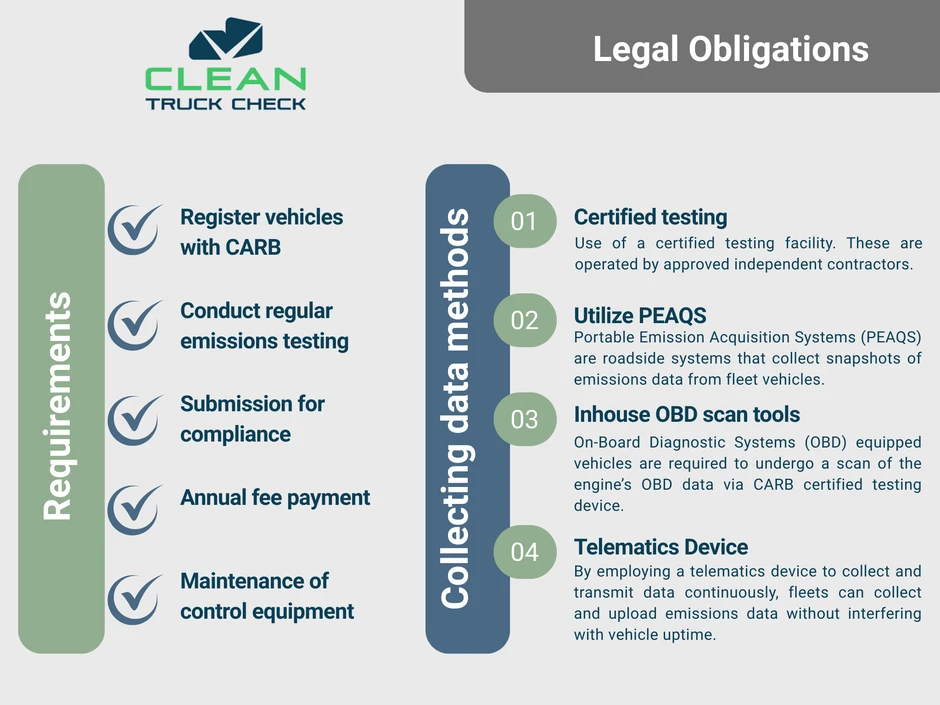
CARB has established specific testing schedules based on vehicle age and technology, creating different compliance paths for different fleet compositions.
Vehicle Classification and Testing Requirements
CARB separates compliance requirements into two categories based on engine model year:
Vehicles with 2013+ Engine Model Years (OBD-Equipped): These newer vehicles use onboard diagnostics systems for emissions monitoring and must submit to OBD testing twice per year initially. After three years of operation, this requirement increases to four times per year.
Vehicles with Pre-2013 Engine Model Years (Non-OBD): Older vehicles without OBD systems require more intensive manual testing. These vehicles must pass visual and functional inspections twice per year, with diesel vehicles also requiring smoke opacity tests twice annually using SAE J1667-compatible equipment.
Clean Truck Check relies on authorized testers who complete CARB's free online training and pass the accompanying examination. Fleet operators can choose to train internal staff as authorized testers or contract with external testing services. Some telematics service providers also offer these services using approved OBD devices.
Screening and Enforcement Process
CARB employs roadside screening systems like PEAQS (Portable Emission Acquisition System) at locations including weigh stations and border crossings to identify high-emitting vehicles. When vehicles are flagged, owners receive a Notice to Submit to Testing (NST) and have 30 days to provide passing emissions test results to CARB.
Additional Compliance Criteria
Beyond compliance fee payment & testing frequency, vehicles must meet several other qualifications:
- No outstanding enforcement actions against the vehicle
- No outstanding emissions-related recalls or OBD issues
- Complete owner and vehicle information reported to CARB's database
- Passing compliance test submitted to CARB within required timeframes
If a vehicle is flagged as non-compliant, it will not be legally allowed to operate on California public roads, and it may face DMV registration holds, fines, or enforcement action (for example, non-compliant trucks may be denied access to ports, freight terminals, or work zones that require CARB compliance).
The compliance fee applies annually to satisfy vehicle compliance deadlines and is paid as part of meeting program requirements. The program affects not just California-based fleets but any heavy-duty vehicles operating on California roads. This creates compliance obligations for interstate carriers and companies using third-party logistics providers.
Recent Developments Shape Strategic Planning
July 2025 brought significant amendments to the ACT regulation that expand strategic options for manufacturers and, indirectly, for companies selecting carriers:
Credit Pooling Between States: Manufacturers can now transfer ZEV credits between California and other Section 177 states that have adopted ACT requirements. This interstate credit system begins in 2027 with a 20% transfer allowance, declining to 10% by 2032.
Enhanced Flexibility: Manufacturers gain additional options for meeting requirements, including using credits from smaller truck classes to offset deficits in larger vehicle categories.
Clean Truck Check Fee Increases: The compliance fee per vehicle will rise from the current $31.18 to $32.13 to reflect the California Consumer Price Index (CCPI). The new fee will take effect with the 2026 annual fee paid to satisfy requirements for vehicle compliance deadlines on and after January 1, 2026.
These changes signal intensifying focus on freight transportation emissions while providing mechanisms to manage compliance costs across broader geographic markets.
The Supply Chain Impact: From Regulation to Operational Reality
These regulations create measurable impacts throughout transportation networks. Companies must understand how ACT and Clean Truck Check requirements influence carrier performance, costs, and availability.
Carrier Investment Pressures: ACT requirements drive manufacturers to prioritize zero-emission vehicle production. Early adopting carriers investing in these vehicles may charge premium rates initially to offset higher vehicle costs.
Operational Cost Variations: Clean Truck Check compliance costs vary by fleet age, maintenance practices, and vehicle technology. Carriers with newer, well-maintained fleets typically demonstrate lower compliance costs (less frequent inspections & need for potential repairs) and better emissions performance.
Route and Service Considerations: California's regulations affect not just in-state operations but interstate commerce. Carriers must factor compliance costs into pricing for California-bound freight, potentially influencing route optimization and modal shift decisions.
Strategic Implementation: Optimizing Truck Transportation for CARB Compliance
Effective CARB compliance strategies require understanding both carrier capabilities and operational requirements. CARB regulations create both compliance costs and optimization opportunities within transportation operations. The most successful companies use these requirements as catalysts for improving transportation network efficiency while reducing both costs and compliance risks.
CARB Compliance Requirements for Carriers
Two Strategic Approaches Based on Fleet Structure
For Shippers Using Third-Party Carriers:
Most shippers rely on trucking companies to move their products. These companies face unique challenges in managing CARB compliance through their carrier networks:
- Service Continuity Risk: Carriers with compliance failures may face operational restrictions, disrupting delivery schedules.
- Cost Pass-Through Management: Understanding how compliance costs affect transportation pricing and contract negotiations.
- Carrier Performance Evaluation: Assessing which carriers maintain compliant, efficient operations.
- Long-Term Partnership Planning: Identifying carriers with sustainable ZEV adoption strategies.
For Shippers with Private Fleets:
Companies operating their own delivery or distribution fleets face direct compliance obligations:
- Direct Compliance Management: Meeting Clean Truck Check requirements across fleet operations.
- Capital Investment Planning: Developing ZEV adoption timelines aligned with business needs.
- Operational Cost Control: Optimizing routes and maintenance to minimize compliance expenses.
- Performance Benchmarking: Comparing fleet efficiency against industry standards.
Carrier Selection and Performance Management
CARB compliance requirements provide new criteria for evaluating trucking carriers. Companies can leverage these regulations to improve carrier selection and contract negotiations:
Clean Truck Check Compliance Tracking: Through direct integration with telematics and ELD systems, VesselBot captures actual freight truck performance data including fuel consumption, routes, and operational efficiency. This data enables companies to identify which carriers maintain well-performing fleets, potentially indicating lower Clean Truck Check compliance costs and operational risks.
ZEV Adoption Leadership: Evaluate carriers investing early in zero-emission vehicles. These carriers position themselves to meet evolving CARB requirements and avoid future compliance disruptions. Shippers can use this intelligence to build long-term partnerships with forward-thinking carriers.
Strategic Route Analysis for California Compliance: Analyze transportation networks and distinguish between shipments that must transit California versus others that could use alternative routing options or even mode of transport. Account for additional compliance costs on California-bound freight; route flexible shipments around regulatory requirements.
Technology Solutions for Compliance Intelligence: Spreadsheets and periodic carrier audits cannot provide the continuous compliance monitoring needed for CARB requirements. Advanced technology platforms automate compliance monitoring and provide strategic intelligence for transportation decisions.
Real-Time Compliance Tracking: VesselBot's platform monitors carrier performance through Electronic Logging Device (ELD) systems and telematics providers. This approach delivers shipment-level visibility into emissions compliance status rather than relying on carrier self-reporting.
Automated Performance Benchmarking: VesselBot's platform integrates with Transportation Management Systems (TMS) to eliminate manual data entry while providing continuous visibility into carrier performance across emissions compliance, efficiency, and service metrics.
Predictive Risk Analysis: Advanced analytics identify which carriers, routes, and operational patterns deliver optimal performance across cost, service, and compliance risk factors. This enables proactive carrier management rather than reactive problem-solving.
Financial Impact: Sustainability ROI in Trucking Operations
CFOs increasingly view CARB compliance through ROI lenses. These regulations create opportunities to demonstrate measurable financial returns from transportation optimization initiatives.
Cost Management Through Strategic Carrier Selection
Accurate compliance intelligence reveals cost-optimization opportunities throughout transportation networks. Shippers achieve measurable savings through:
- Risk-Based Carrier Selection: Identifying carriers with lower compliance risk profiles reduces service disruption costs
- Route Consolidation: Strategic California freight consolidation minimizes exposure to compliance-related cost increases
- Contract Negotiation: Using compliance performance data to negotiate more favorable terms with high-performing carriers
Risk Mitigation and Operational Benefits
Clean Truck Check compliance costs can reach thousands of dollars annually for large carrier fleets. Service disruptions from compliance failures can cost shippers even more through delayed deliveries and customer dissatisfaction.
California CARB compliance requirements demand proactive risk management strategies. VesselBot provides intelligent emissions data that helps shippers mitigate these risks by providing advanced visibility into carrier CO2 emissions status and performance trends. This enables proactive carrier management and contingency planning.
Moreover, companies demonstrating measurable transportation efficiency performance gain advantages in customer relationships and sustainability reporting, particularly when serving California markets.
Conclusion: Strategic Action for Competitive Advantage
CARB's Advanced Clean Trucks regulation and Clean Truck Check program create both operational challenges and strategic opportunities for supply chain organizations. Companies that view these requirements as simple compliance obligations miss significant opportunities for transportation optimization and cost reduction.
The most successful organizations treat Clean Trucks regulations as catalysts for improving carrier selection and transportation network efficiency. These regulations provide concrete criteria for evaluating transportation partners based on fleet modernization, compliance performance, and operational reliability.
Success requires moving beyond basic compliance monitoring to strategic transportation management. Shippers must identify carriers investing early in zero-emission vehicles, maintain visibility into emissions compliance performance, and optimize California-bound freight routing to minimize regulatory exposure and cost increases.
VesselBot's Supply Chain Sustainability Platform enables this strategic approach by monitoring actual carrier performance data through telematics and ELD integration. This visibility helps companies identify which carriers maintain well-performing fleets that consistently meet emissions standards, potentially indicating lower Clean Truck Check compliance costs and reduced operational risks.
The choice is clear: treat CARB's clean truck regulations as operational burden or use them as catalyst for transportation optimization and competitive advantage. With proper carrier selection and route optimization strategies, organizations can emerge stronger, more efficient, and better positioned for continued success in California's evolving transportation landscape.
Furthermore, early adopters gain first-mover advantages by building relationships with forward-thinking carriers and developing expertise in compliance-aware logistics before these capabilities become market requirements.
Ready to transform your CARB compliance into competitive advantage? Discover how VesselBot's Supply Chain Sustainability Platform helps industry-leading companies optimize their transportation operations while managing compliance risks and achieving sustainability targets.