Open any corporate sustainability report published and you will find the same narrative arc. Emissions targets are set. Progress is described. The mechanisms cited are familiar:
- carbon credits purchased,
- SAF acquired through book-and-claim systems,
- a modal shift or two.
The report closes with a commitment to continue.
What rarely appears in that report: a clear account of where emissions actually originate in the supply chain, which carriers, routes, and operational decisions drive the most carbon, what changed in operations as a result of the decarbonisation program, and what the company now knows about its logistics that it did not know before.
That gap is not an accident. It is the predictable result of a specific choice, made early in most decarbonization programs, to optimize for speed and cost over operational insight. Understanding why that choice gets made, and what it forecloses, is the difference between a program that produces disclosures and one that produces actual reductions.
The path of least resistance
Book-and-Claim and carbon credits are not fraudulent. They serve a legitimate compliance function: they allow companies to account for emissions reductions that occur elsewhere in the value chain and apply them against their own reported footprint. In practice, they allow organizations to buy a carbon number without yet building the operational capability to reduce it. Under current regulatory frameworks, that accounting is valid.
The problem is not the instrument. The problem is what this instrument replaces.
When a company purchases SAF certificates or carbon credits to meet a near-term emissions target, it closes a reporting gap without touching the operational reality underneath it. The logistics network continues to run exactly as it ran before. The same carriers move the same freight on the same routes with the same utilization rates. The emissions are still happening. They are simply being offset somewhere else on paper.
That is a choice companies are entitled to make. But it is worth being precise about what this means: this means the organization has chosen not to learn anything about how its supply chain operations drive emissions. No hotspot has been identified. No carrier has been selected or deselected based on actual performance. No routing decision has been made differently. The decarbonization program has produced an accounting outcome, not an operational one.
The logic behind using carbon credits
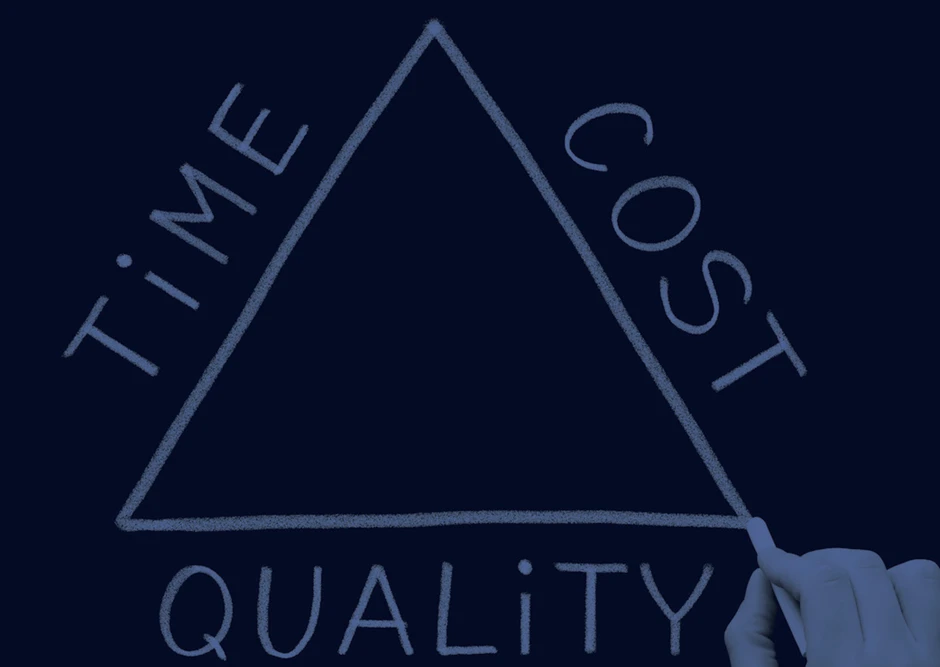
Every decarbonization initiative gets evaluated against the same three forces that govern any operational investment: quality, cost, and time. In logistics decarbonization, those three forces are structurally difficult to satisfy simultaneously. The way most organizations resolve that tension determines whether their program ever produces real reductions.
Quality, in this context, means data that is decision-grade:
- calculated at shipment or movement level,
- traceable back to actual execution rather than industry averages,
- consistent across modes and carriers, and
- re-calculable when methodologies or regulations change.
This kind of primary data tells you which carrier on which lane is actually performing better, how a blank sailing affected your emissions exposure, what your real utilization rate was versus the 70% assumed by standard methodology frameworks.
That data is harder to produce than an offset certificate. It requires integration with carrier systems, actual voyage tracking, and a methodology that can handle the real-world variability of ocean networks: route deviations, anchorage waiting time, vessel swaps, and schedule changes, that invalidate the assumptions built into most average-based calculations.
Cost is where the trade-off becomes explicit. The cost of offset mechanisms appears manageable in the short term. But it is not a fixed cost. Carbon credit prices move with market conditions, regulatory changes, and increasing scrutiny of offset quality. SAF certificate prices follow fuel markets and supply constraints. A company that builds its decarbonization program around purchasing compliance, is building a cost exposure that scales with its footprint and with regulatory pressure. The data foundation, by contrast, gets more valuable over time. Once the integration is in place, once the methodology is established, once the data flows at shipment level, the organization has an asset it can use across carrier and mode selection, network design, regulatory reporting, and procurement conversations. The offset certificate is spent the moment it is issued.
Time is where the logic becomes hardest to argue against in the short term. Carbon credit can be purchased and accounted for in weeks. An execution-grade emissions data foundation takes longer to build. If the reporting deadline is next quarter, the credit wins on time every time.
But time has two meanings here. Time to a number is how quickly a figure appears in a disclosure. Time to operational value is how quickly the program produces something that changes a decision. Most organizations choose the first. That is how you end up with fast disclosures and programs that look identical in year five to how they looked in year one.
The consequences of choosing compliance over capability
The choice to optimize for a reportable outcome rather than operational understanding does not stay contained to the sustainability team. It has downstream consequences that become harder to manage as regulatory pressure increases.
Regulations are moving toward requiring companies to demonstrate not just that they have offset emissions, but that they have measured and managed their emissions at source. The EU ETS for maritime, CSRD's requirements around auditable Scope 3 data, and the trajectory of disclosure standards in UK, US and other jurisdictions are all converging on the same expectation: show your actions, not just your number. An offset certificate does not show actions. It shows a transaction.
Procurement teams that want to use emissions data in carrier selection conversations cannot do so with trade-lane averages. Aggregate data tells you nothing about how a specific carrier performs on a specific lane under real execution conditions. You cannot negotiate emissions performance with a supplier when your own data is less granular than what they could provide you with.
Imagine two carriers operating the same Asia–Europe lane. One consistently sails with higher utilization and fewer deviations, producing significantly lower emissions per container. Without shipment-level emissions data, a shipper sees both as identical.
And operationally, the organization that has not built an execution-grade data foundation is not positioned to act when the primary decarbonization levers it is counting on do not materialize at scale. SAF supply remains constrained. Alternative fuel technologies are not deployed at the pace that many net zero roadmaps assumed. When those levers are not available, the organizations that have invested in understanding where their operational emissions actually originate have choices. The organizations that have been buying credits have a credit bill and no operational insight to fall back on.
From reporting output to operational input
The difference between a compliance program and a decarbonization program shows up in one place: whether the emissions data operationalize logistics sustainability.
In a compliance program, the emissions number is the output. It goes into a report. The cycle ends.
In a decarbonization program, the emissions number is an input. It informs carrier allocation. It changes how shipment consolidation decisions get made. It identifies which trade lanes are carrying disproportionate emissions load and why. The sustainability team is not the end point of the data. They are the bridge between data and the procurement, logistics, and network design teams who can act on it.
That program built on that logic requires a data foundation that can support an operational conversation, not just a regulatory one. It requires knowing what your carriers actually emit under real voyage conditions, not what the industry average assumes they emit. It requires being able to identify hotspots at shipment level, track changes over time, and answer the question a CFO or procurement director will eventually ask: which specific changes in how we move freight produced which specific reductions, and what did it cost to achieve them?
Book-and-claim cannot answer that question. An offset certificate cannot answer that question. Only execution-grade operational data can.
A short-term instrument with long-term consequences
The organizations that default to offset-led programs are not, in most cases, making a cynical choice. They are making a rational one given the constraints they face: short reporting timelines, limited internal data maturity, and budget conversations that favor low upfront cost.
The honest framing is this: offset mechanisms and book-and-claim are a valid short-term instrument for closing a reporting gap while the operational foundation is being built. They become a problem when they permanently substitute for that foundation, because every year spent buying compliance is a year not spent building the capability to reduce.
If your current program produces emissions numbers that cannot be traced back to actual execution, recalculated when a regulation changes, or defended in a procurement conversation about carrier performance, the foundation is the issue. And a strategy built on a weak foundation will stay aspirational regardless of how well it is constructed.
That is a solvable problem. But solving it requires addressing the foundation, not patching the surface.
VesselBot was built to give sustainability, procurement, and logistics teams the data infrastructure that operationalizes logistics sustainability. That means, real-time execution-grade emissions data on a voyage-level, derived from AIS signals and digital twin modelling, not trade-lane averages. It means carrier and schedule benchmarking based on how freight actually moved, so that procurement conversations are grounded in execution rather than assumption. It means hotspot identification at shipment level, so the organization knows precisely where its emissions load originates and why. And it means integration with the TMS, ERP, and carrier systems the logistics operation already runs on, so the data flows into the decisions being made every day rather than sitting in a separate reporting environment.
Real decarbonization does not start with the report. It starts with understanding how your supply chain is actually performing. Everything that follows, the carrier decisions, the network adjustments, the reduction targets that hold under scrutiny, depends on that picture being real. That is the difference between buying a carbon number and building a decarbonization capability.