Access shipment-level data built on actual transport execution across ocean, air, road, rail, and parcel. Most transportation emissions data is built on assumptions. VesselBot's Logistics Intelligence Platform provides execution-grade emissions data derived from real-world operations, enabling accurate reporting, confident operational decision-making, and AI-driven optimization to achieve cost and emissions reductions.
Scope 3 transportation emissions are typically calculated using industry averages, modeled assumptions, and carrier-reported estimates. While sufficient for reporting, these approaches fail to reflect actual shipment execution.
As a result:
This is not a reporting gap. It is a data foundation problem.
Calculations Based on Global Average Methodologies hinder effective decision-making
Industry-standard calculation methods overestimate emissions by up to 131%
Comparative analysis of emissions calculation methods, demonstrating VesselBot's accuracy over traditional approaches.
When emissions data is not grounded in execution:
Logistics teams cannot act on it.
Sustainability teams cannot defend it.
Finance teams cannot trust it.
Procurement teams cannot negotiate on it.
Make confident operational decisions based on actual emissions measurements, not industry averages.
VesselBot replaces estimated emissions with shipment-level calculations derived from real-world voyage data.
Every shipment is modeled based on:
The result is emissions data that reflects what actually happened, not what was assumed.
Shipment-Level Accuracy
Granular emissions calculated for every shipment across all transport modes.
Multi-Modal Coverage
Ocean, air, road, rail, and parcel unified into a single dataset.
Full Traceability
Transparent methodology with auditable data lineage aligned with GLEC, ISO, and regulatory frameworks.
Consistent Global Baseline
Standardized calculations across carriers, regions, and trade lanes using one methodology.
One data lake. One source of truth for transportation emissions across the organization.
Customer
Systems
Tracking & External Data
Existing Connectivity Network
Carriers
FFW / 3PL
Parcel Carriers
*Track & Trace or CSV files
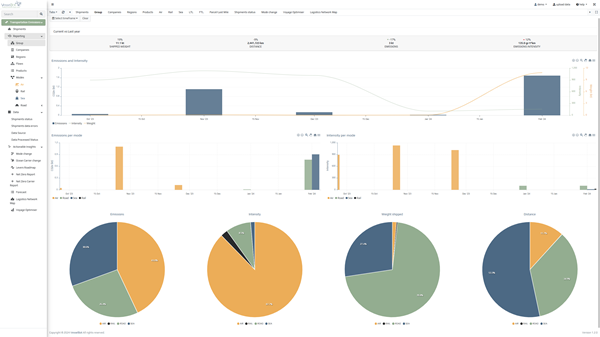
VesselBot Dashboard
Internal Systems
Achieve shipment-level accuracy across your entire multimodal network
Powered by proprietary Digital Twin models for vessels and aircraft, combined with real-time telematics data for ground transportation.

Our Digital Twin technology creates an exact virtual replica of each vessel in the global merchant fleet, monitoring real-time performance and environmental impact. By incorporating actual voyage data, weather conditions, and port operations, we deliver the most precise maritime emissions calculations in the industry.
VesselBot's Digital Twin Model incorporates:
VesselBot's Logistics Intelligence Platform recently ranked #1 in Drewry's Emissions Measurement Providers Comparison Guide, achieving an impressive score of 9.89 out of 10 for ocean freight emissions calculations, with nearly perfect marks across Drewry's rigorous evaluation criteria.

Unlike standard emissions calculations based on averages, our Logistics Intelligence Platform tracks each individual flight's actual performance and conditions. We integrate real-time flight data with aircraft-specific Digital Twins to provide unmatched accuracy in air freight emissions monitoring.
VesselBot's Logistics Intelligence Platform recently ranked #1 in Drewry's Emissions Measurement Providers Comparison Guide, with an exceptional score of 8.2 out of 10 for air freight emissions calculations.

Through direct integration with telematics (TMS) providers worldwide, we capture actual performance data across your entire truck transportation fleet.
When telematics data isn't fully available.
We maintain superior accuracy through modeled data, a sophisticated approach that creates frameworks to analyze and interpret primary data:

We capture the actual performance of all major commercial rail networks worldwide.

View Deliveries through a Sustainability Lens
Leverage VesselBot’s advanced technology to map your network and measure emissions. Track emissions using primary data for each shipment leg:
Calculate emissions at the package level:
Execution-grade emissions data does more than support reporting. It enables organizations to:
Designed for Cross-Functional Business Leadership
Through shipment consolidation
Through AI-powered optimization
Via integrated logistics data & sustainability analytics
Through automated data collection and harmonization
Disclaimer: Results drawn from client use cases. Outcomes vary based on network complexity, data maturity, and operational starting point.
Common questions about execution-grade emissions data, shipment-level measurement, and how VesselBot delivers accuracy across every transport mode.
Execution-grade emissions data is calculated from actual shipment execution, not from modeled averages or carrier-reported estimates. VesselBot captures real-world operational inputs such as vessel movements, routes, transshipment paths, utilization rates, and mode-specific conditions at the shipment level across all transport modes. This produces emissions data that reflects operational reality, supports audit-ready reporting, and enables organizations to identify and act on real decarbonization opportunities.
Most emissions calculations based on averages are inaccurate because they do not reflect what actually happened during each shipment. Industry-average methodologies use generalized assumptions about routes, distances, load factors, and fuel consumption, which ignore real-world variations such as actual routing, transshipments, delays, and utilization. As a result, they produce estimates that can significantly deviate from actual emissions and cannot support precise reporting or operational decision-making.
A digital twin is a virtual replica of a physical asset that is continuously updated with real-world operational data to model how it performs in practice. In freight emissions, VesselBot uses digital twins of vessels, aircraft, and ground transportation assets, enriched with data such as routes, speeds, utilization, and operating conditions. This allows emissions to be calculated based on actual shipment execution rather than industry averages, so every calculation reflects the specific conditions of each shipment.
VesselBot calculates ocean freight emissions using digital twins of individual vessels, based on actual voyage execution rather than trade-lane averages. Each digital twin incorporates vessel characteristics such as size, type, fuel, and engine specifications, combined with real journey data including routes, speeds, port operations, and anchorage times. AIS satellite data tracks vessel movements across global ports, ensuring each calculation reflects the specific conditions of that shipment.
VesselBot calculates air freight emissions using digital twins of individual aircraft, based on actual flight execution rather than averaged factors. Flight data is captured via ADS-B satellite tracking and linked to specific shipments using identifiers such as flight number or airway bill, then combined with aircraft performance characteristics, real routes, and load factors. This enables flight-specific emissions calculations that reflect actual operating conditions for each shipment.
VesselBot calculates ground transportation emissions using mode-specific data for road, rail, and parcel operations, based on actual execution rather than standardized assumptions. For road, it integrates directly with telematics providers to capture fuel consumption, cargo weight, utilization, and routes across FTL and LTL operations. For rail, it tracks performance across commercial rail networks, incorporating locomotive types, cargo loads, and railway segments. For parcel, it measures emissions at the package level across each shipment leg using carrier fleet data, network design, and utilization rates.
Shipment-level accuracy matters because emissions data must reflect actual execution to support operational decisions, not just reporting. When emissions data is based on averages, logistics teams cannot act on it, sustainability teams cannot defend it, finance teams cannot trust it, and procurement teams cannot use it in negotiations. Execution-grade emissions data enables organizations to identify carrier performance differences, reveal consolidation opportunities, calibrate carbon credit purchasing to actual emissions, and support AI-driven network optimization.
VesselBot meets global emissions reporting standards by providing audit-ready, traceable data aligned with leading regulatory frameworks. It is Smart Freight Centre (SFC) accredited in compliance with the GLEC Framework, aligned with ISO 14083, and supports reporting under CSRD, ESRS E1, CBAM, CDP, and the GHG Protocol. Every figure is traceable to actual shipment execution data, providing the transparency and granularity required by regulators and auditors.
VesselBot's emissions calculation methodology is different because it is built on execution-grade, shipment-level data derived from actual transport execution rather than industry averages. It combines real-world data sources such as AIS, ADS-B, telematics, and carrier Track & Trace with Digital Twin models of vessels and aircraft to calculate emissions based on actual routes, speeds, loads, and operating conditions. This produces calculations that reflect operational reality, enabling accurate reporting and allowing organizations to evaluate and act on trade-offs across cost, service, and carbon.
Our Logistics Intelligence Platform complies with the European standards for calculating carbon emissions. Our system is SFC accredited in compliance with the GLEC Framework for global coverage of air, sea, road, rail, inland waterways, and logistics hubs. As the ISO:14083 standard was developed in line with the GLEC Framework, our calculator is also ISO:14083 and CDP aligned.