The Trump administration's escalating tariff regime has created unprecedented supply chain disruption across global trade. Recent industry intelligence reveals mounting pressure on businesses as retaliatory measures intensify worldwide, with the President's 28 documented policy changes since "Liberation Day" creating an environment of constant uncertainty.
With Trump's August 1st reached today, recent negotiations have produced mixed results across key trading partners. While breakthrough deals with the EU (15% tariffs) UK (10% tariffs), Japan (15%), and several other countries have reduced rates from their initial levels, negotiations with China remain stalled at 30% tariffs, and the overall trade environment remains volatile for businesses planning their supply chains.
Supply Chain Disruption Escalates Across Global Trade
The latest industry briefings show alarming trends. China's import numbers have dropped to their lowest levels in 20 years, forcing companies to rapidly restructure their supply chains. Vietnam and Cambodia have emerged as alternative manufacturing hubs, yet these countries also face Trump administration pressure through threatening letters demanding different trade terms.
While recent negotiations have produced deals with several countries the overall trade environment remains volatile. China negotiations seem stuck, and the administration's pattern of policy reversals creates ongoing uncertainty for supply chain planning.
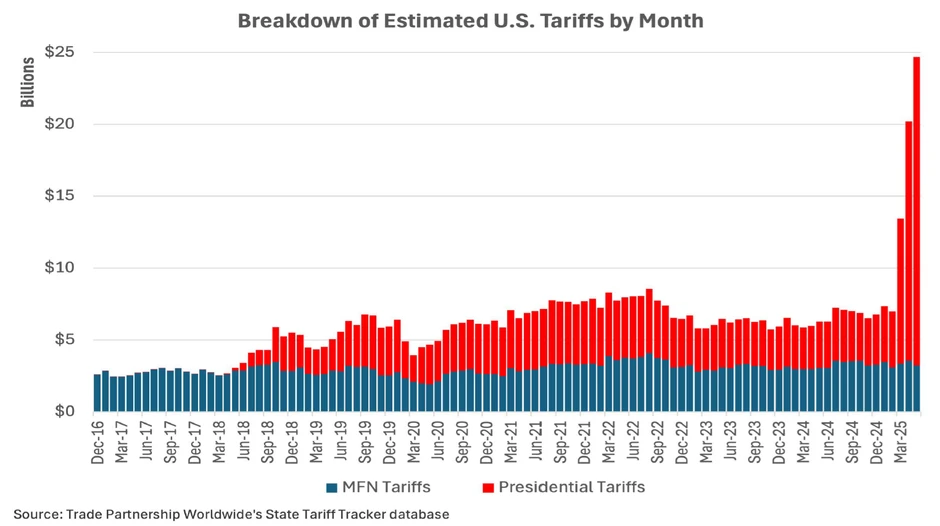
Meanwhile, Section 301 tariffs and presidential authority measures continue expanding. The first six months of 2025 generated record tariff collections, with $100 billion extracted from corporate and individual pockets. This represents the highest collection rate in decades, directly impacting business operations and consumer costs.
Transportation and Logistics Bear the Brunt
The transportation sector faces particularly severe disruption from current tariff policies. Industry data reveals carriers' profit margins are declining as shipping rates drop, while suppliers struggle to cope with demand fluctuations. This creates a cascading effect throughout global supply chains.
Recent Port of Los Angeles data shows this volatility in action. The port recorded its best June ever with 892,340 TEUs processed, driven by importers racing to beat Trump's August deadline for Chinese goods. However, this surge masks deeper structural problems as companies face a "tariff whipsaw effect", alternating between import rushes and dramatic slowdowns.
European ports tell a similar story from the export side. The Port of Antwerp-Bruges reports a 15.9% drop in vehicle exports to the US, with thousands of cars, vans, and trucks sitting idle as manufacturers grapple with 25% tariffs. Truck and heavy equipment exports have plummeted 31.5%, reflecting how tariffs devastate high-value goods markets .
Container shipping routes from China to U.S. ports show dramatic volume decreases, forcing carriers to restructure networks and reduce service frequency. Although Vietnam and Cambodia have emerged as alternative manufacturing hubs, companies face new challenges including transshipment tariffs of up to 40% that target goods beginning their production journey in China even when finished elsewhere.
The maritime industry faces additional pressure from Section 301 fees targeting Chinese vessel operators and Chinese-built ships. These measures, detailed in our previous analysis, will escalate dramatically through 2028, potentially adding millions in costs per vessel rotation. This compounds existing challenges as carriers simultaneously deal with reduced cargo volumes and increased operating expenses.
Corporate Margins Under Severe Pressure
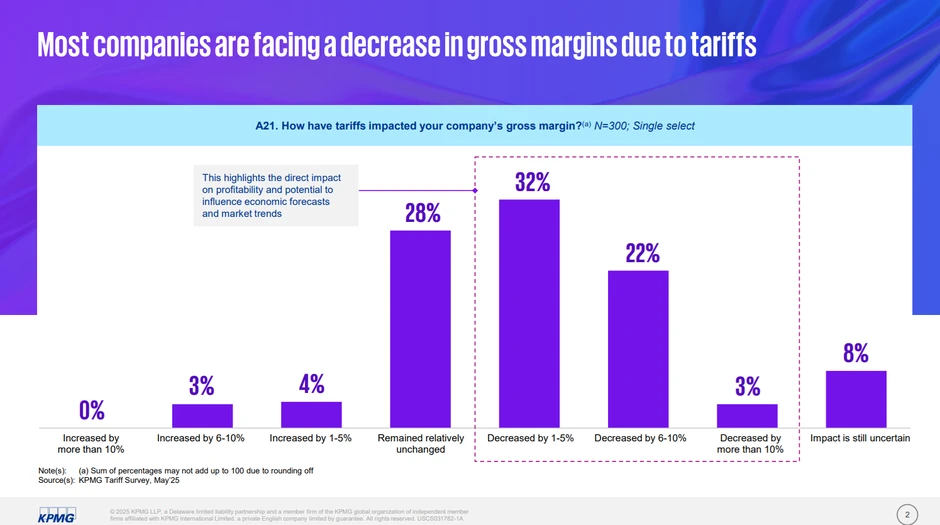
Recent KPMG research reveals the devastating impact on U.S. businesses: 57% of companies report declining gross margins as a direct result of tariffs, with 25% seeing drops greater than 6%. The survey of 300 large U.S. companies shows companies face a severe margin squeeze with 32% experiencing 1-5% declines and 22% seeing 6-10% drops.
International sales are particularly affected, with 83% of companies reporting reduced sales in China due to retaliatory tariffs. The data shows 51% of companies experienced significant declines, with 32% seeing drops of 6-10% and 31% experiencing decreases exceeding 10% in Chinese markets alone. Nearly a third have experienced 16-25% drops in foreign sales overall, demonstrating how trade tensions create losses far beyond direct tariff costs.
The response time for supply chain restructuring reveals the challenge: 46% of companies require 7-12 months to make significant supply chain changes, while only 11% can pivot within 1-2 months. This indicates moderate agility levels that may be insufficient for the rapid policy changes ahead.
Strategic Response Requires Data-Driven Optimization
Given the ongoing transportation disruptions and rising margin pressures, supply chain leaders must make smarter, faster decisions. Traditional planning models are no longer sufficient. In fact, 55% of companies are actively reconfiguring their supply chains in response to tariffs, and 46% report that major changes take 7 to 12 months to implement. This slow pace of adaptation cannot keep up with today’s rapidly changing market conditions. To remain competitive, executives must embrace dynamic planning driven by real-time data and analytics that adapt to rapidly changing market conditions.
The Port of Los Angeles' record June followed by anticipated August volume drops exemplify the "tariff whipsaw effect" that's making freight planning extremely difficult. When European ports experienced 15.9% drops in vehicle exports before the recent EU deal while U.S. ports experience dramatic volume swings, supply chain professionals need detailed performance data to navigate these disruptions effectively.
Companies are exploring reshoring as a long-term solution, with 69% believing it's feasible to bring manufacturing to the U.S. within 1-2 years. However, the barriers remain substantial: higher operating costs (66%), higher labor costs (61%), and capital investment requirements (48%). This means most companies will continue relying on global supply chains for the foreseeable future, making optimization critical.
The solution lies in data-driven optimization. While companies can't control tariff announcements or port disruptions, they can control how they respond to them. Having access to precise data at the shipment level can reveal which carriers and shipping lanes deliver the best results. When every percentage of cost reduction matters, companies need to base their decisions on facts, not guesswork. This approach can transform supply chain management from reactive to proactive, helping companies maintain their competitiveness even as trade conditions continue to evolve.
The ROI of Emissions Intelligence
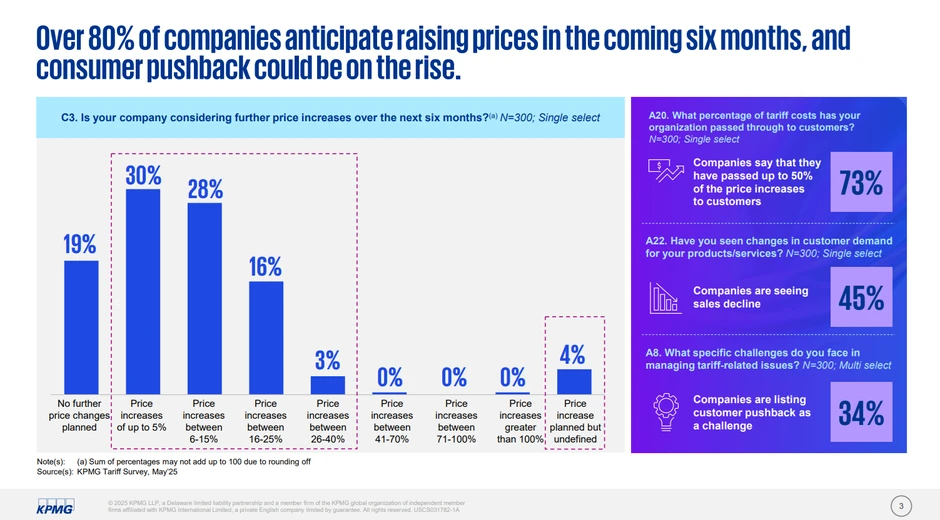
Against this backdrop of operational chaos and financial pressure, smart companies are finding opportunities. The current environment where 81% of companies plan price increases while facing customer pushback, creates an opportunity for those with superior logistics intelligence. Companies that can optimize their supply chains costs and emissions will maintain competitive advantages even as tariff pressures intensify.
The transportation volatility and margin pressures outlined above make supply chain optimization not just an operational imperative, but a potential profit center. Forward-thinking leaders use real-time sustainability data to navigate supply chain disruption while achieving measurable ROI by addressing operational challenges through both efficiency improvements and financial precision.
An additional competitive advantage lies in the use of shipment-level emissions analysis that enables both operational and financial optimization. By evaluating carrier efficiency and shipping lane performance, companies can uncover cost-saving opportunities
Moreover, precise emissions calculations enhance financial planning, enabling accurate forecasting of carbon-related costs. With a clear understanding of their actual carbon footprint, businesses can make data-driven decisions on sustainability investments, avoiding unnecessary spending on carbon credits or biofuels.
This precision becomes a competitive differentiator when 57% of companies report declining gross margins and every dollar is under scrutiny.
Preparing for Continued Escalation
As Trump's August 1st deadline has arrived and recent negotiations have produced mixed results, companies must prepare for continued uncertainty. This preparation requires robust analytical capabilities to model different scenarios and their impact on costs and operations. Organizations with high-quality data insights will navigate these challenges more effectively than those relying on traditional planning methods.
The intersection of trade policy disruption and operational requirements creates both challenges and opportunities for C-suite leaders. Companies that view this crisis as a catalyst for supply chain optimization will build lasting competitive advantages.
Success in today’s supply chain landscape requires a shift from reactive responses to proactive optimization. This involves using emissions data not merely for compliance, but as a strategic asset for driving operational excellence. VesselBot’s Logistics Intelligence platform delivers shipment-level emissions calculations and real-time data, empowering companies to uncover optimization opportunities and make informed decisions that reduce costs and carbon emissions simultaneously.
Companies that master this approach will reduce costs, improve efficiency, and build resilient supply chains capable of thriving in an increasingly complex global environment. The current disruption will eventually stabilize, but the companies that use this period to fundamentally improve their supply chain intelligence will maintain their advantages long after the immediate crisis passes.
The question facing C-suite leaders is not whether to adapt, but how quickly they can transform their logistics operations to succeed in this new reality.