
California's groundbreaking climate legislation creates unprecedented reporting requirements for large businesses. As the world's fourth-largest economy, California sets global precedents that ripple across industries worldwide, making its California climate disclosure law developments critical to monitor regardless of your company's location.
However, these regulations also present a strategic opportunity to transform sustainability compliance into operational excellence and cost reduction.
Understanding California Climate Disclosure Law Requirements
California's climate disclosure laws are now moving from legislation to implementation, with critical deadlines approaching that will fundamentally change how businesses approach sustainability reporting:
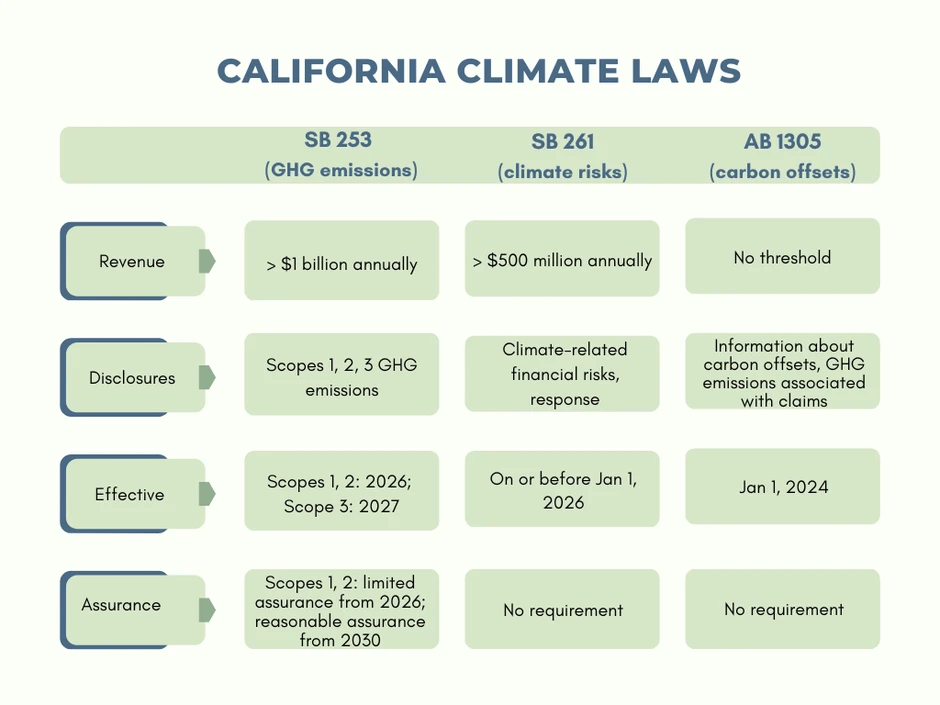
SB-253 (Climate Corporate Data Accountability Act) requires companies with annual revenues exceeding $1 billion to disclose Scope 1, 2, and 3 Greenhouse Gas (GHG) emissions. Scope 1 and 2 reporting begins in 2026, while Scope 3 reporting starts in 2027.
SB-261 (Greenhouse gases: climate-related financial risk Act) mandates climate-related financial risk disclosures for companies with revenues over $500 million. These reports must detail both climate risks and adaptation measures, with the first reports due by January 1, 2026.
SB-219 amended both SB-253 and SB-261 in September 2024, establishing key implementation deadlines and providing CARB with additional regulatory guidance authority. Importantly, SB-219 introduces parent-level consolidation options, allowing companies to report consolidated emissions data at the parent company level rather than filing separate reports for each subsidiary. However, each qualifying entity remains subject to individual fees regardless of consolidated reporting.
AB-1305 (Voluntary Carbon Market Disclosures Act) addresses a separate but related aspect of climate transparency, requiring detailed disclosures about carbon offset purchases and net-zero claims. This law took effect on January 1, 2024, and operates independently from the CARB-regulated emissions and climate risk reporting requirements.
Who Must Comply?
California climate disclosure law applies to both public and private companies that "do business in California," regardless of physical presence in the state. The revenue thresholds are based on total global revenue, not just California-specific income.
CARB defines "revenue" as total global sales from business activities without deducting operating costs or business expenses.
Companies qualify as "doing business in California" if they meet either criterion:
- The entity operates or maintains a commercial domicile in California, OR
- California sales exceed $735,000 annually (2024 threshold, adjusted yearly for inflation)
Implementation Fees: What Companies Will Pay
CARB's workshop revealed specific fee structures that companies can now incorporate into budget planning. CARB recommends a "flat" fee per regulated entity, with the flat annual fee for each program determined by dividing the total annual program cost by the number of covered entities.
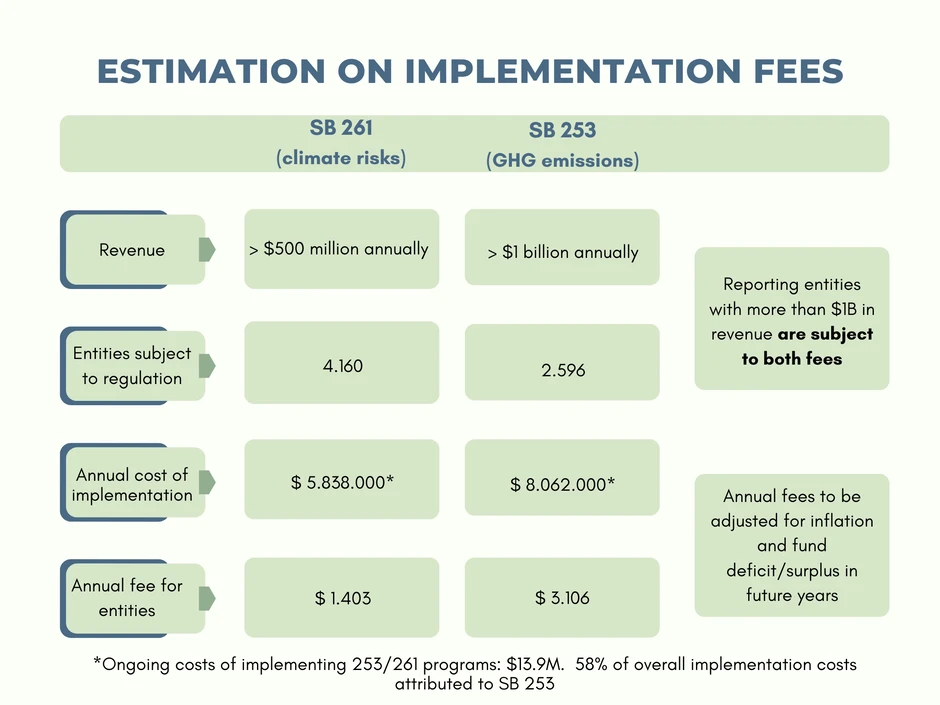
This fee structure provides much-needed clarity for companies developing compliance budgets, though the exact amounts will depend on the final number of covered entities.
Critical Deadlines Approaching Fast
Despite regulatory delays, reporting deadlines remain firm. At CARB's May 29, 2025 public workshop, officials confirmed that implementing regulations won't be ready until "by the end of the year [2025]" instead of the original July 1, 2025 deadline. This delay creates uncertainty for companies trying to determine their compliance obligations.
However, CARB has firmly reiterated that statutory reporting deadlines will not change:
- January 1, 2026: First climate risk reports due (SB-261)
- 2026: Scope 1 and 2 emissions reporting begins (SB-253) for fiscal 2025 data
- 2027: Scope 3 emissions reporting starts (SB-253) for fiscal 2026 data
The exact date in 2026 when emissions reports will be due remains unclear, and it's uncertain whether year-end regulations will be in draft or final form. Nevertheless, gathering and auditing emissions data can take months, making immediate preparation essential.
To ease the transition, CARB has reaffirmed its December 2024 enforcement notice stating no penalties will be imposed for incomplete SB-253 reporting in 2026, provided companies demonstrate good faith efforts and retain all relevant emissions data.
Companies must obtain third-party assurance for their emissions data. Limited assurance is required for Scope 1 and 2 emissions starting in 2026, escalating to reasonable assurance by 2030.
The Strategic Transportation Opportunity
While compliance might seem burdensome, forward-thinking executives are recognizing these requirements as catalysts for operational transformation. Compliance is a means to an end, not an end by itself. The key lies in moving beyond basic compliance toward strategic supply chain optimization.
Professionals need to prepare for a fundamental shift in stakeholder expectations, from climate pledges to demonstrable results. This transition demands access to increased data quality and rigorous, investor-grade disclosures that can withstand scrutiny and drive meaningful business decisions. Companies must invest in building internal capabilities that extend far beyond regulatory requirements.
Transportation emissions typically represent a significant portion of a company's total carbon footprint, yet most organizations lack visibility into where and how to reduce these emissions effectively. Average-based and spend-based emissions calculations provide limited actionable insights for decision-makers..
Primary emissions data serves as the foundation for operational improvements that deliver both environmental and financial benefits. Unlike industry averages that provide generic benchmarks, precise shipment-level measurements reveal specific optimization opportunities hidden within your supply chain operations.
Accurate emissions data unlocks four critical areas of operational improvement:
Carrier Performance Optimization: Real-time emissions data reveals which carriers deliver the best performance across cost, service, and environmental metrics for each trade lane. This intelligence enables more strategic contract negotiations and carrier selection decisions based on actual performance rather than assumptions.
Route and Modal Optimization: Granular shipment-level data identifies opportunities for modal shifts and route changes that simultaneously reduce emissions and transportation costs. Companies can model different scenarios to find the optimal balance of service, cost, and environmental impact.
Shipment Consolidation Opportunities: Detailed shipment analysis reveals patterns where cargo consolidation can reduce both emissions and freight costs while maintaining service levels. This data-driven approach eliminates guesswork in logistics planning.
Strategic Carbon Management: Instead of over-purchasing carbon credits based on rough estimates, precise measurements enable companies to buy exactly what they need. This accuracy eliminates waste while ensuring legitimate offset strategies that stand up to scrutiny.
The ROI of Strategic Compliance
Companies taking a strategic approach to climate compliance are realizing significant returns while building internal capabilities that drive long-term value:
- Up to 12% emissions reduction through data-driven carrier optimization
- Up to 4,000 working hours saved annually by eliminating manual data collection
- Up to 1.3% of transportation cost savings through intelligent shipment consolidation
- Precise carbon credit purchases that eliminate overbuying and reduce compliance costs
These improvements stem from having visibility into actual transportation performance rather than relying on estimates and industry averages. Moreover, training logistics and procurement teams to use enriched primary emissions data as a strategic tool for carrier selection, route optimization, and cost management creates lasting organizational capabilities that extend far beyond compliance requirements.
Avoiding Common Pitfalls
Many companies are making critical mistakes in their compliance preparation, such as:
Over-reliance on estimates: Using industry averages instead of real-time data leads to inaccurate reporting and missed optimization opportunities.
Treating compliance as a reporting exercise: Companies focused solely on meeting disclosure requirements miss the strategic value of enriched primary emissions data.
Inadequate integration: Standalone sustainability reporting systems fail to deliver operational value to logistics and procurement teams.
Reactive approach: Waiting until deadlines approach limits your ability to implement strategic improvements and capture cost savings.
Compliance should be seen as a means to an end, not an end by itself. Companies must move from a compliance mindset to a value creation mindset, where proactive competence becomes key for business success. The organizations that will thrive are those that view these requirements as opportunities to build lasting competitive advantages.
Take Action Now
California's climate disclosure laws represent just the beginning of a broader regulatory trend. Other states, including New York, Illinois and Washington State, are developing similar legislations, while international regulations like the EU's Corporate Sustainability Reporting Directive (CSRD) require similar disclosures.
The deadline for California climate compliance is approaching rapidly. Companies that start now with a strategic mindset will discover that these requirements offer a pathway to both regulatory compliance and operational excellence.
CARB has signaled leniency in first-year enforcement for companies making good faith efforts to comply. This grace period provides an opportunity to build robust systems that go beyond basic reporting to drive operational value. The new parent-level consolidation options also provide additional flexibility for multi-entity organizations to streamline their reporting processes while maintaining compliance
The question isn't any more whether you'll need to comply – it's whether you'll use compliance as a catalyst for transformation.
Start by focusing on your transportation network, where the biggest opportunities for both emissions reduction and cost savings typically lie. Transform your approach from reactive compliance to proactive optimization. Turn sustainability targets into operational advantages through precise emissions measurement and strategic supply chain optimization.
Ready to transform your compliance requirements into competitive advantages? Discover how VesselBot's Logistics Intelligence Platform can help you achieve up to 15% emissions reduction while cutting transportation costs. Get seamlessly and effortlessly the actionable insights you need to meet California's deadlines and optimize your operations simultaneously.