There is no shortage of ambition when it comes to supply chain decarbonization. Large shippers have set targets. Scope 3 emissions are firmly on the agenda. Transportation emissions are under scrutiny from regulators, customers, and investors alike. And yet, when you look at how decarbonisation is actually being executed, a different picture emerges. The challenge is not intent. It is execution.
Key Takeaways
- The gap between decarbonization targets and outcomes is not a commitment problem. It is a data and decision problem.
- Most data labeled "primary" in freight emissions is not primary. Carrier and forwarder data is typically aggregated, built on standardized factors, and reflects industry averages rather than actual shipment execution.
- Data sufficient to report is not the same as data sufficient to decarbonize and optimize operations. The type of data a company holds defines the range of decisions available to it.
- Companies that build execution-level data infrastructure gain operational control, not just a compliance posture. They can forecast freight cost exposure, validate fuel surcharges, and select carriers based on verified performance rather than reported estimates.
The Comfort of Financial Instruments
One of the clearest signals from the market is where companies are able to unlock budget.
It is significantly easier to secure internal approval for mechanisms like Book & Claim than for operational change. The reason is simple.
Book & Claim behaves like a financial instrument. It is predictable, auditable, and fits within existing approval frameworks. You can quantify the outcome, assign a cost, and report progress without disrupting how logistics operates. It delivers a result that is easy to explain. Operational decarbonization does not.
Changing carriers, redesigning networks, shifting modes, or improving consolidation introduces complexity. These decisions cut across procurement, logistics, and commercial teams. They force trade-offs between cost, service, and carbon.
They challenge the way organizations make decisions. This is where resistance appears. Not because companies do not want to decarbonize, but because operational change requires coordination, accountability, and, in most cases, strong top-down direction.
Without that, sustainability remains a reporting layer, not an operational capability.
The Illusion of “Primary Data” in Logistics Emissions
At the same time, most organizations recognize that better data is required to move forward. There is a clear push toward higher data quality. But there is also a fundamental misunderstanding that continues to slow progress. What is often labeled as “primary data” in freight emissions is, in many cases, not primary at all.
Data received from carriers or freight forwarders is frequently aggregated. It is based on averages, standardized emission factors, or methodologies such as those defined by Smart Freight Centre and the GLEC framework.
These approaches are valuable for consistency and reporting. But they do not reflect actual shipment execution.
They do not capture real routing, delays, transshipments, equipment variations, or how assets are operated in practice. They rely on assumptions that smooth out the very dynamics that define modern logistics networks.
As a result, companies believe they have the data needed to act, when in reality they have data sufficient to report. And that distinction matters because the type of data you have determines the type of decisions you can make.
Freight Emissions Data: A Shift Toward Execution
This is where a different group of companies is starting to diverge. Forward-thinking organizations are moving beyond reporting and focusing on execution. They are investing in shipment-level visibility. They are combining internal data with carrier track-and-trace and external signals to reconstruct how freight actually moves. They are building a shared data foundation across logistics, procurement, and sustainability teams. Not for compliance. For control.
With this level of visibility, emissions become part of operational decision making. They can be evaluated alongside cost and service in real time. Trade-offs become explicit. Decisions become measurable, and most importantly, they become actionable.
This unlocks a different set of levers:
- Carrier and schedule selection based on real performance. Network adjustments that reduce both cost and freight emissions.
- Improved consolidation and asset utilization.
- Reduced reliance on reactive, high-cost interventions.
- Sustainability, in this context, is no longer a separate initiative. It becomes embedded in how logistics are run.
From Obligation to Advantage
This is where the strategic impact becomes clear. In a market shaped by constant disruption, rising fuel costs, and increasing regulatory pressure, the ability to understand and adapt your logistics network is no longer optional. It is a source of competitive advantage.
Companies that operate with execution-level data can anticipate change, simulate alternatives, and make informed decisions before costs materialize. In practice, this means moving beyond static assumptions and understanding how emissions - and therefore cost - change based on how a shipment is actually executed.
For example, on a Shanghai–Rotterdam route, commonly used methodologies can produce materially different emissions outcomes for the same shipment. Industry-average approaches, such as Clean Cargo, estimate emissions at around 795 kg CO₂e per TEU, while more detailed segmented calculations can exceed 1,020 kg. In contrast, execution-level, voyage-based data shows actual emissions closer to 1,011 kg per TEU, a difference that can change which carrier, routing, or schedule is considered “optimal” depending on the objective. (See full analysis)
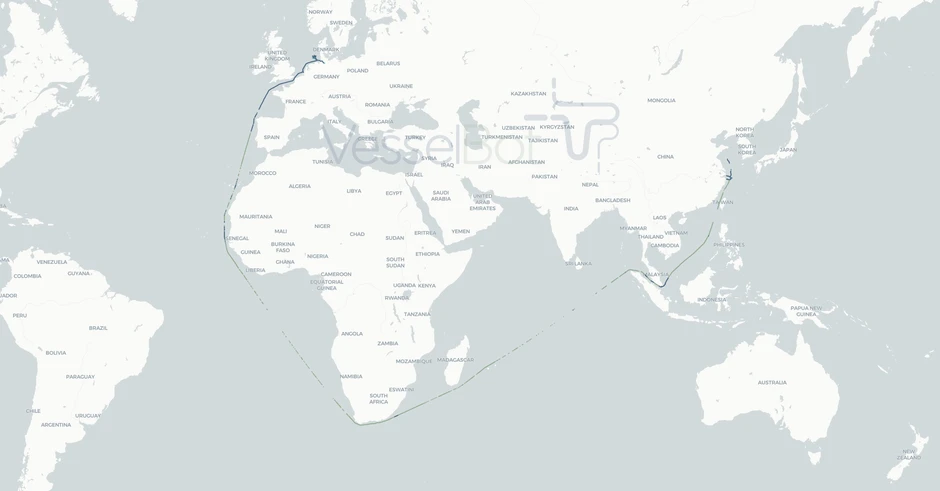
The image depicts the AIS signals the vessel emitted during its voyage from Shanghai to Rotterdam
That difference becomes critical in the context of the EU ETS, where carbon is a direct and variable cost. In 2026, the system requires 100% of emissions on intra-EU voyages and 50% on voyages to or from the EU to be covered by allowances, meaning the same shipment profile can carry very different cost exposure depending on how it is routed and executed. While total cost is ultimately driven by actual emissions and allowance prices, the ability to accurately estimate and attribute those emissions determines how well companies can forecast exposure and validate carrier surcharges. In a recent shipper example, a company moving 478 TEU on intra-European routes would see its exposure increase under the new rules, with ETS-related surcharge reaching €28 per TEU, resulting in over €13,000 in annual impact for a single trade lane. Across the industry, total ETS costs are expected to exceed €2 billion in 2026, with further upside driven by carbon price volatility. (Full breakdown)
In contrast, organizations that remain anchored in aggregated data will continue to rely on external instruments to meet their targets. Useful, but ultimately disconnected from the operational reality where value is created.
The Real Constraint in Supply Chain Decarbonization
Decarbonization in logistics is not constrained by ambition. It is constrained by three factors:
- Incentives that favor easy-to-justify actions over impactful ones.
- Organizational complexity that slows down operational change.
- Data that is not aligned with how logistics actually operates.
These three constraints are not independent. They reinforce each other.
Incentives favor financial instruments because organizational complexity makes operational change difficult. Organizational complexity persists because the data available does not give cross-functional teams the shared operational picture needed to make trade-offs visible. And because data quality remains insufficient, the incentive structure never shifts. The cycle holds.
Breaking it does not require a new emissions target. It requires a different data foundation, one built on how freight actually moves rather than on how it is assumed to move on average. When freight emissions are calculated at the shipment level, using actual routing, vessel performance, and voyage parameters, they stop being a sustainability metric and become an operational variable. They can be weighed against cost and service in the same decision. That is when behavior changes, not because companies become more committed to decarbonization, but because the data makes the better decision visible and defensible.
This is where the competitive dimension becomes concrete. Disruption, fuel volatility, and regulatory cost exposure are not going away. A company that understands its actual freight emissions profile can forecast EU ETS exposure, challenge inflated surcharges, and select carriers based on verified performance rather than reported estimates. A company operating on aggregated data cannot do any of these things with confidence. It can report progress. It cannot reliably produce it.
The companies that close the supply chain decarbonization gap first will not necessarily be the ones with the most ambitious targets. They will be the ones who treated emissions as an operational problem, built the data infrastructure to manage it, and gave their logistics, procurement, and sustainability teams a shared foundation for making decisions that are both measurable and consequential.
Decarbonization is not just a sustainability challenge; it is a data and decision problem. And for companies that solve it, it becomes a lever not only for compliance, but for performance and long-term competitive advantage.
SOURCES
- Scope 3 Calculation Guidance
- GLEC Framework for Logistics Emissions Accounting (Smart Freight Centre)
- Clean Cargo
- EU ETS
About the author: Constantine Komodromos is the Founder and CEO of VesselBot, the company that built execution-grade, shipment-level freight emissions intelligence for global shippers across ocean, air, and land transport.

With a background spanning over 20 years in finance and business advisory, he has provided strategic direction and financial management across challenging and volatile environments, with a proven track record of increasing profitability, reducing operating expenses, and managing risk. That foundation shaped a different lens on how global organizations approach logistics data and emissions measurement.

Over ten years of leading VesselBot, working directly with Fortune 500 manufacturers and global shippers across Europe and North America, he has developed a clear view of where logistics data fails large organizations and what it takes to fix it. His work focuses on replacing industry averages and carrier-reported estimates with actual voyage execution data, so that Scope 3 transportation emissions become an operational KPI evaluated at the moment of planning and execution.

He was named to the TIME100 Most Influential Climate Leaders list. VesselBot holds the #1 ranking in the latest Drewry's  Emissions Measurement Providers Comparison Guide and was recognized as a Gartner Cool Vendor in Supply Chain Management Technology. His work has been applied by global manufacturing and shipping companies seeking to align emissions reporting with operational decision-making.

He holds the designations of Fellow of the Association of Chartered Certified Accountants (FCCA) and Certified Member of the Institute of Internal Auditors (CMIIA).